

In my last article, I explained why daily stretching matters so much for spinal health — how the spine depends on a balance between muscle and bone, and how your intervertebral discs rely on movement to stay nourished. But a question I hear from patients all the time is this: what is actually happening inside my body when I stretch? Why does stretching too fast make things worse, not better?
That's exactly what I want to address here. This isn't just theory — understanding the science behind stretching has genuinely changed the way many of my patients approach their daily routine, and I think it will change yours too.
Speed Matters: Why the Way You Stretch Changes Everything
Here's something most people don't realise: before your body lets a muscle release, it runs a quick check on how you're moving.
Inside your muscles sit tiny sensory receptors called muscle spindles (Muscle Spindles — sensory receptors embedded within muscle fibres that monitor the speed and range of a stretch). The moment you begin to stretch, these spindles are already tracking your movement. If you pull too fast or too forcefully, they immediately send a signal back to the same muscle — triggering a reflexive contraction to protect against tearing. In other words, the harder and faster you try to force a stretch open, the more your body fights back. The tension you feel doesn't ease; it intensifies.
The opposite is also true. When you stretch slowly, steadily, and hold that position for a period of time, a different set of receptors — the Golgi Tendon Organs (GTO — sensory receptors located at the junction between muscle and tendon, responsible for sensing sustained tension) — gradually come online. These respond to prolonged, consistent load by doing the opposite of the spindles: they tell the muscle to let go. This process is known as autogenic inhibition (a neurological response that actively relaxes the very muscle being stretched). It's the body's built-in release mechanism, and you can only access it with patience.
The takeaway, as I tell my patients, is this: stretching isn't about pulling hard or going as far as possible in one go. It's about rhythm, control, and staying in it. Rush the process and your body closes the door. Go slowly and steadily, and it opens.
Fascia and Structural Remodelling: Stretching Goes Much Deeper Than You Think
Most people imagine stretching as something that simply "loosens" the muscles. But the reality is far more layered — quite literally.
Surrounding every muscle and organ in your body is a connective tissue called fascia (Fascia — a web of connective tissue that wraps around muscles, organs, and structures throughout the entire body). Healthy fascia is made up of layers of crimped collagen fibres (Crimped Collagen Fiber Network — the wave-like arrangement of collagen within fascia that gives it both elasticity and the ability to recoil). Think of these fibres like a coiled spring: when they're healthy and hydrated, they stretch and bounce back naturally.
Think of it as the oil between moving parts. When the body moves regularly, this lubrication stays fluid and the layers glide freely. When it doesn't, the layers start to bind — and you feel it every time you turn, bend, or reach.
But there's something even more significant at work with consistent, long-term stretching. Through a process called sarcomerogenesis (Sarcomerogenesis — the addition of new sarcomere units to muscle fibres in response to sustained stretch, physically increasing the muscle's resting length), the muscle fibre itself can actually grow longer at the structural level. This isn't a temporary loosening. This is genuine physical change.
I like to explain it this way: imagine a shopping mall that decides to expand. They're not rearranging the existing shops or shuffling furniture around. They're knocking down walls, building a new wing, andincreasing the floor space. Once that new wing is built, the extra capacity doesn't disappear when footfall increases. Your muscles work the same way. Consistent, sustained stretching doesn't just make you feel better in the moment — it builds something that stays.
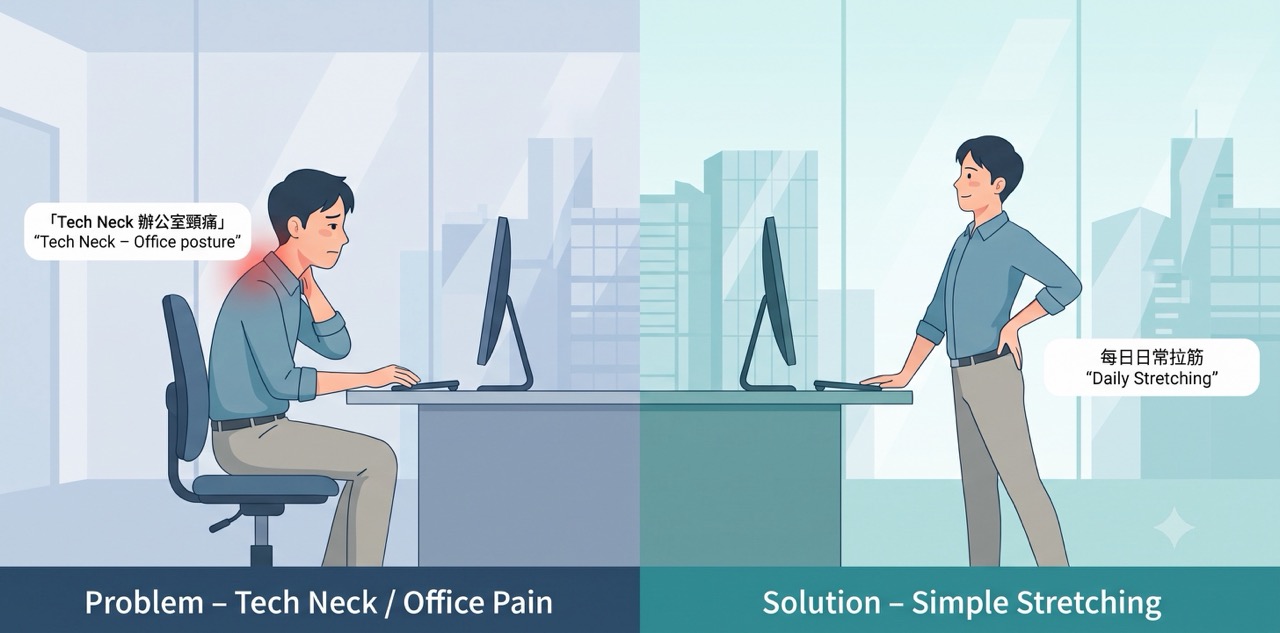
Chiropractic Care and Stretching: Why You Need Both
One of the most common misconceptions I encounter in practice is this: "I've had an adjustment — shouldn't everything be sorted now?"
Not quite. Chiropractic care and daily stretching work on different but complementary levels. Think of the adjustment as a system reinstall on a computer — immediately afterwards, everything runs smoothly. But if you go back to the same habits, accumulating clutter and never running a cleanup, it won't be long before performance degrades again. The adjustment is the reinstall. Your daily stretching is the maintenance routine.
The table below shows how I explain the distinction to patients:
| Daily Stretching 🧘 | Chiropractic Care 🩺 | |
|---|---|---|
| Purpose | Releases chronic tension; maintains daily flexibility and soft tissue health. | Professional spinal adjustments to improve joint alignment and range of motion. |
| How they work together | Post-treatment stretching prevents soft tissues from re-tightening; consolidates the effects of care. | Assessment-guided care with a personalised stretching plan tailored to the individual. |
| Primary target | Muscles,tendons, ligaments. | Joints, physiological alignment, nerve irritation and compression sites. |
| Effect | Gradual reduction in muscle tension, improved mobility, less proned to stiffness | Immediate improvement in joint range of motion, reduced joint pressure. |
| Sustained results | Cumulative; deepens over time with consistent habit; sarcomerogenesis can permanently increase muscle resting length. | Immediate and noticeable; but without stretching to support it, soft tissue tension can cause gradual regression. |
| Impact on spinal alignment | Indirect support — reduces muscular pull on the spine, helps achieve better alignment | Direct adjustment — immediately improves mobility through Golgi Tendon response. |
| Effect on fascia | Directly promotes fascial gliding; promotes lubrication. | Improved joint mobility reduces overall fascial tension. Passive movement also promotes lubrication |
| Best suited for | Everyone — especially post-treatment maintenance; also ideal for desk workers, people who look down at phones a lot, and anyone with poor postural habits | Anyone with muscular discomfort, limited joint movement, neck or back pain, sciatica, or those who need professional assessment |
| How to combine them | Daily, consistently — especially as home care between and after chiropractic sessions | Scheduled as appropriate, with a personalised stretching plan provided by your chiropractor |
The adjustment opens the door. Stretching keeps it open.
Frequently Asked Questions
How long do I need to hold a stretch for it to be effective?
It matters less how long any single stretch lasts, and more whether you're doing it consistently every day. The goal is to give your nervous system and soft tissues enough repeated exposure to the movement that genuine adaptation can take place. One long stretch once a week will always lose out to a short stretch done daily.
Do I still need to stretch after a chiropractic adjustment?
Absolutely — and I cannot overstate this enough. A chiropractic adjustment can restore joint mobility and improve spinal alignment, but if the surrounding muscles remain chronically tight, they will gradually pull things back to where they were. Stretching is what locks in the gains. Without it, the effects of treatment are much more likely to be short-lived.
What is fascia, and why does it matter for the spine?
Fascia is the connective tissue that wraps around every muscle, organ, and structure in your body. When it becomes adhered through lack of movement, it places uneven mechanical load on the spine — contributing to discomfort and restricted movement. Stretching directly addresses this by promoting fascial gliding and stimulating the lubrication between layers.
Can stretching actually make muscles permanently longer?
Through the process of sarcomerogenesis, yes — consistent, sustained stretching can physically increase the resting length of a muscle by prompting the addition of new sarcomere units along the muscle fibre. This is a structural change, not a temporary feeling. However, it requires time and consistency to accumulate. There are no shortcuts — but the results are lasting.
What's Coming Next
In my next article, I'll be moving from the theory into the practical — sharing the stretches I actually recommend to my patients for daily spinal maintenance, including simple routines you can do at home without any equipment.
Spinal health rarely falls apart in a single moment. It erodes gradually — through the accumulated weight of poor posture, insufficient movement, and the kind of tension that builds so slowly you stop noticing it. Daily stretching is one of the most accessible ways to push back against that. But if you're already experiencing persistent neck tightness, back pain, or discomfort that doesn't ease with movement, that's your body telling you something worth listening to. A professional assessment by a registered chiropractor may be the right next step.
Follow me on Instagram and Facebook for more spinal health insights from Chiropractor Ronan Chan.