Why Hong Kong Workers Need Stretching: Insights from Dr Ronan

Ronan's Everyday Stretching Guide for Hong Kong Lifestyles

Want a practical starting point for building stretching into your daily routine? Read this guide first, then come back to this article for the occupational health perspective.

The Hidden Cost of a High-Pressure Career in Hong Kong

For the modern Hong Kong office worker, the physical toll of a high-pressure career often manifests in common workplace discomforts: stiff neck, rounded shoulders, and chronic lower back pain. Working in one of the world's most competitive environments frequently involves many hours a day spent hunched over your workspace, a posture that places strain on the spine. For every centimeter your head tilts forward, the effective weight on your neck increases significantly, potentially leading to tension headaches and spinal discomforts.

These are not isolated complaints. A 2024 spinal health survey by HKSH Medical Group found that 87% of respondents experienced spinal pain within the past year, with back pain (58%) and neck pain (54%) being the most common symptoms. The same survey noted that 36% of respondents said their spinal problems affected their work, and prolonged sitting, common among white-collar workers, was identified as a significant contributor to back and neck pain. As a chiropractor, I see this pattern reflected constantly in my Hong Kong clinic: professionals whose daily work routines are quietly reshaping their spines long before pain ever appears.

Stretching acts as a vital reset button for these professionals, breaking the cycle of static loading by lengthening and opening the spine. By integrating short, targeted stretching breaks into the workday, office workers can improve circulation to their spinal discs and reduce the risk of repetitive strain injuries that are so prevalent in dense corporate regions, like Hong Kong.

Occupational Pressures Across Different Industries

While every desk-based worker benefits from movement, stretching is particularly helpful for specific high-stress roles common in Hong Kong. Each industry places a distinct mechanical demand on the body, depending on posture, repetitive movement, and hours spent in a fixed position.

Finance and Banking: The Screen-Locked Posture

Finance and banking professionals often suffer from intense shoulder and neck tension due to market-driven stress and prolonged sitting during trading hours. Sitting still while mentally tracking fast-moving markets tends to lock the shoulders and neck into a fixed, tense position for hours, compounding the mechanical strain of sitting itself.

IT and Software Development: Tech Neck and Repetitive Strain

IT and software developers are prone to carpal tunneling symptoms and "tech neck" from focusing on multiple monitors. Constantly shifting focus between screens encourages a forward head posture, while repetitive keyboard and mouse use places ongoing strain on the wrists and forearms.

Luxury Retail and Hospitality: Lumbar Strain from Standing

Those in the luxury retail and hospitality sectors, who spend entire days on their feet, rely on stretching to relieve pressure on the lumbar spine. Standing for extended periods without rest places continuous downward load on the lower back, which is mechanically very different from the sitting-related strain seen in office-based roles, but no less taxing on the spine.

Regardless of the industry, a sedentary or repetitive job creates mechanical imbalances that require proactive care to reduce its straining effects.

At-a-Glance: Industry-Specific Spinal Strain

Key spinal strain patterns across common Hong Kong industries

Industry Common Physical Strain Underlying Work Pattern
Finance and Banking Intense shoulder and neck tension Market-driven stress and prolonged sitting during trading hours
IT and Software Development Carpal tunnel symptoms and "tech neck" Focusing on multiple monitors for extended periods
Legal Professionals Mid-back stiffness Hours of continuous document review
Luxury Retail and Hospitality Pressure on the lumbar spine Spending entire days standing on their feet

Stretching as an Occupational Health Strategy

For the Hong Kong workforce, stretching isn't just about wellness — it's a necessary strategy for occupational health, ensuring that a demanding career doesn't result in a permanent loss of mobility or chronic pain. This point carries extra weight when set against the HKSH survey findings that nearly half (48%) of respondents with spinal problems reported sleep disturbances, and 37% experienced negative emotions such as anxiety, depression, and irritability due to pain or limited mobility. Viewed through this lens, stretching functions as a preventive intervention rather than a reactive one, addressing mechanical imbalances before they progress into persistent pain patterns.

Occupational Health Perspective: Before and After Stretching

How regular stretching changes key occupational health factors

Occupational Health Factor Unaddressed Strain (No Stretching) Managed Strain (With Regular Stretching)
Spinal Loading Static loading accumulates from prolonged sitting or standing. Cycle of static loading is broken through lengthening and opening the spine.
Neck Posture Forward head tilt increases effective weight on the neck, risking tension headaches. Reduced strain on the neck through regular movement breaks.
Circulation Reduced circulation to spinal discs from lack of movement. Improved circulation to spinal discs from targeted stretching breaks.
Injury Risk Higher risk of repetitive strain injuries in dense corporate environments. Reduced risk of repetitive strain injuries.
Long-Term Mobility Risk of permanent loss of mobility or chronic pain from sustained mechanical imbalance. Musculoskeletal health remains mobile through proactive, daily care.

FAQ

Why are Hong Kong office workers especially prone to spinal problems?

Many Hong Kong office workers spend long hours hunched over a workspace in a highly competitive environment, and this posture places sustained strain on the spine, contributing to stiff neck, rounded shoulders, and chronic lower back pain. This is consistent with survey data showing that 87% of Hong Kong respondents experienced spinal pain within the past year, with prolonged sitting cited as a key contributing factor.

Does every profession experience the same type of physical strain?

No. Different professions create different mechanical demands — finance and banking professionals tend to experience shoulder and neck tension from prolonged sitting during trading hours, IT professionals develop "tech neck" and carpal tunnel symptoms from multi-monitor work, legal professionals develop mid-back stiffness from document review, and retail or hospitality workers experience lumbar spine pressure from standing all day.

How does stretching help with occupational health specifically?

Stretching breaks the cycle of static loading by lengthening and opening the spine, improving circulation to the spinal discs, and reducing the risk of repetitive strain injuries associated with sedentary or repetitive work.

Is stretching only relevant for people who sit all day?

No. A sedentary or repetitive job of any kind — whether it involves sitting, standing, or repetitive movement — creates mechanical imbalances in the body that require proactive care such as stretching to reduce straining effects.

Can workplace-related spinal strain affect more than just physical health?

Yes. Beyond physical discomfort, spinal problems have been shown to affect sleep and emotional wellbeing, with nearly half of surveyed individuals reporting sleep disturbances and over a third reporting negative emotions linked to spinal pain or limited mobility.
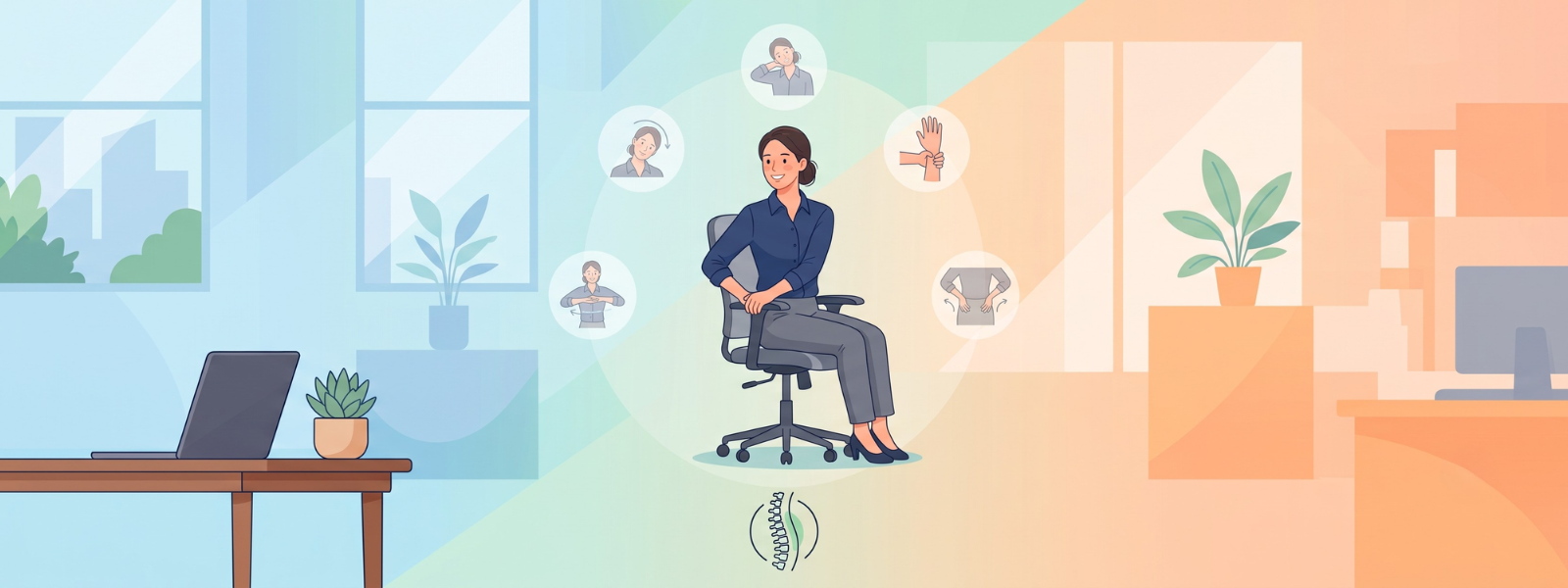
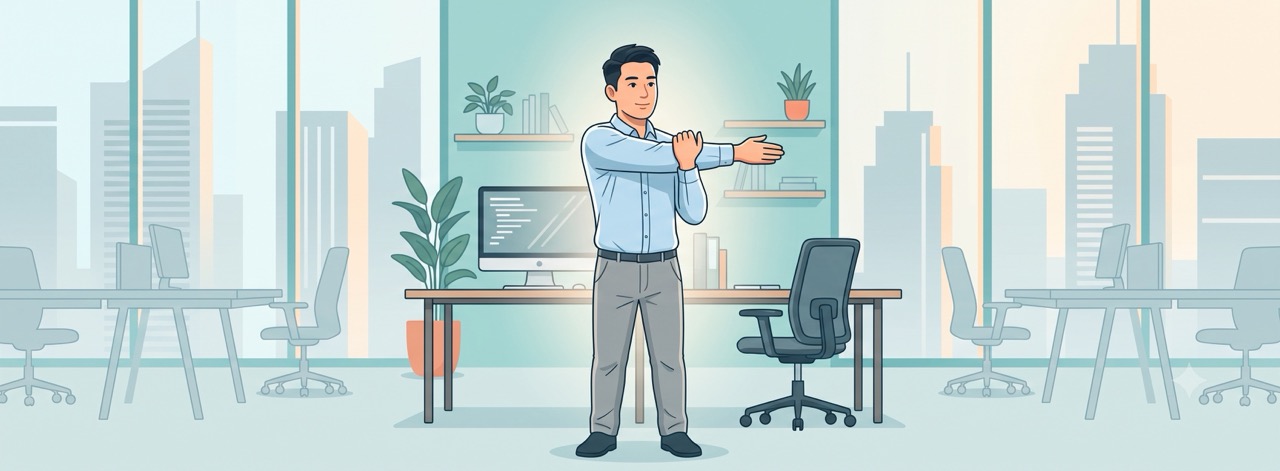
Ronan’s Everyday Stretching Guide for Hong Kong Lifestyles

Building a Daily Stretching Habit

In my previous article, I explained why stretching is so important for your spine and nervous system, especially in a busy city like Hong Kong where static postures quietly wear down your body over time. This time, I want to move from theory to practice and guide you through simple stretches you can use to build a realistic daily habit..

You don’t need a gym or specialized equipment to protect your spine. You can significantly improve your workplace ergonomics right from your desk in just five to ten minutes. For most office stretches, I recommend holding each position for 30 to 60 seconds – this gives your nervous system enough time to release its protective tension without causing muscle fatigue..

In this article, I will walk you through four targeted stretches:

  • Side and back of your neck
  • Chest and shoulders
  • Hips and glutes
  • Hamstrings and legs

These movements are designed to be practical for everyday life in Hong Kong, whether you are at your desk, in a meeting room, or sitting at home.

Simple Principles Before You Stretch

Before we go into each movement, I want you to keep three simple principles in mind:

  • You should feel a gentle pulling sensation, not pain.
  • Move into the stretch slowly and avoid bouncing.
  • Breathe steadily and do not hold your breath while stretching.

Integrating these movements every 60 to 90 minutes helps your musculoskeletal system stay mobile throughout the day. Even short stretching breaks can make a noticeable difference when they are repeated consistently over time.

Stretch 1: Seated Levator Scapulae Stretch (Neck)

This first stretch focuses on the levator scapulae, a muscle that runs along the back and side of your neck and often becomes tight from looking down at screens or sitting with your head pushed forward.


How to do it:

  • Sit tall in your chair, with your spine upright.
  • Place one hand behind your head.
  • Gently pull your chin down toward your armpit on the same side, until you feel a pull along the back side of your neck.
  • Hold this position for 30 to 60 seconds, then slowly return to neutral and repeat on the other side if needed.

This stretch helps to combat neck tension that builds up during long periods of sitting and focusing on screens. When practiced regularly throughout the day, it can assist in reducing stiffness and discomfort in the upper neck region.

Stretch 2: Pec Stretch (Upper Chest and Shoulder Front)

The second stretch targets your pectoral muscles in the upper chest, which tend to become shortened when you spend hours typing, using a mouse, or leaning forward. Tight chest muscles contribute to rounded shoulders and a hunched posture.


How to do it:

  • Find an upright surface, such as a wall or door frame.
  • Place your forearms against the surface, with a 90-degree bend at your elbows.
  • Your elbows should be roughly at shoulder height.
  • Gently press your chest forward until you feel a stretch into your upper chest.
  • Hold for 30 to 60 seconds while breathing steadily.

This pec stretch helps counteract the rounded, forward posture that comes from prolonged typing and device use. By opening up the front of the shoulders and chest, it supports a more neutral spinal position.

Stretch 3: Seated Figure Four (Hips and Glutes)

Addressing the lower body is critical for lower back pain relief, especially since tight legs and hips often contribute to pelvic and lower back discomfort. The seated figure four is an excellent beginner-friendly stretch for your hips and glutes.


How to do it:

  • While sitting, place one ankle over the opposite knee, creating a “figure four” shape.
  • Keep your back flat and avoid rounding your spine.
  • Slowly lean forward from your hips until you feel a stretch along the side of your thigh and into your glutes.
  • Hold for 30 to 60 seconds, then switch sides and repeat.

This stretch targets the muscles around the hip and glute region, which, when tight, can mimic sciatica-like symptoms. Regularly performing the seated figure four can help reduce tension in these areas and support more comfortable sitting.

Stretch 4: Seated Hamstring Extensions (Legs and Back of Thighs)

Long periods of sitting can cause your hamstrings to shorten and stiffen, which in turn can affect your pelvis and lower back mechanics. Seated hamstring extensions are a simple way to keep blood flowing and prevent this shortening.


How to do it:

  • Sit upright in your chair with both feet flat on the floor.
  • Straighten one leg out in front of you while remaining seated.
  • Flex your toes toward your shin so you feel a gentle stretch along the back of your thigh.
  • Hold for 30 to 60 seconds, then switch to the other leg.

Performing these hamstring extensions regularly helps maintain the length of the muscles along the back of your legs. It also supports circulation and reduces the impact that prolonged sitting has on your lower body.

Summary Table: Four Everyday Stretches

Stretch name Main area targeted Key starting position Suggested hold time Everyday purpose
Seated Levator Scapulae Back and side of the neck Sitting tall, hand behind head. 30–60 seconds To reduce neck tension from forward head posture and screen use.
Pec Stretch Upper chest and front of shoulders. Forearms on upright surface at 90°. 30–60 seconds To counteract rounded shoulders and hunched typing posture.
Seated Figure Four Hips and glutes, side of thighs. Sitting, ankle crossed over opposite knee. 30–60 seconds To ease hip and glute tightness that can mimic sciatica symptoms.
Seated Hamstring Extensions Hamstrings and back of legs. Sitting, one leg straightened, toes flexed. 30–60 seconds To maintain hamstring length and support lower back comfort while sitting.

FAQ

How often should I do these stretches during the day?

Integrating these movements every 60 to 90 minutes during your workday helps your musculoskeletal health remain mobile and reduces the impact of static loading on your spine.


Do I need any equipment or a gym to perform these stretches?

No. You don’t need a gym or specialized equipment to protect your spine; all four stretches can be performed right from your desk with only a chair and an upright surface like a wall or door frame.


How long should I hold each stretch?

For most office stretches, including the four described here, holding each position for 30 to 60 seconds allows your nervous system to release protective tension without causing muscle fatigue.


Are these stretches enough to manage all my spinal issues?

These stretches are a practical way to break up static postures, improve circulation, and reduce everyday tension on your spine and related muscles. By combining these simple desk stretches with regular chiropractic check-ups, you provide your body with structural support to cope with a demanding professional environment, though they are not a guarantee or standalone solution for every condition.

Why Stretching Works: Muscle Spindles, Fascia & Your Spine — Chiropractor Dr. Ronan Explains


In my last article, I explained why daily stretching matters so much for spinal health — how the spine depends on a balance between muscle and bone, and how your intervertebral discs rely on movement to stay nourished. But a question I hear from patients all the time is this: what is actually happening inside my body when I stretch? Why does stretching too fast make things worse, not better?


That's exactly what I want to address here. This isn't just theory — understanding the science behind stretching has genuinely changed the way many of my patients approach their daily routine, and I think it will change yours too.


Speed Matters: Why the Way You Stretch Changes Everything

Here's something most people don't realise: before your body lets a muscle release, it runs a quick check on how you're moving.


Inside your muscles sit tiny sensory receptors called muscle spindles (Muscle Spindles — sensory receptors embedded within muscle fibres that monitor the speed and range of a stretch). The moment you begin to stretch, these spindles are already tracking your movement. If you pull too fast or too forcefully, they immediately send a signal back to the same muscle — triggering a reflexive contraction to protect against tearing. In other words, the harder and faster you try to force a stretch open, the more your body fights back. The tension you feel doesn't ease; it intensifies.


The opposite is also true. When you stretch slowly, steadily, and hold that position for a period of time, a different set of receptors — the Golgi Tendon Organs (GTO — sensory receptors located at the junction between muscle and tendon, responsible for sensing sustained tension) — gradually come online. These respond to prolonged, consistent load by doing the opposite of the spindles: they tell the muscle to let go. This process is known as autogenic inhibition (a neurological response that actively relaxes the very muscle being stretched). It's the body's built-in release mechanism, and you can only access it with patience.


The takeaway, as I tell my patients, is this: stretching isn't about pulling hard or going as far as possible in one go. It's about rhythm, control, and staying in it. Rush the process and your body closes the door. Go slowly and steadily, and it opens.


Fascia and Structural Remodelling: Stretching Goes Much Deeper Than You Think

Most people imagine stretching as something that simply "loosens" the muscles. But the reality is far more layered — quite literally.


Surrounding every muscle and organ in your body is a connective tissue called fascia (Fascia — a web of connective tissue that wraps around muscles, organs, and structures throughout the entire body). Healthy fascia is made up of layers of crimped collagen fibres (Crimped Collagen Fiber Network — the wave-like arrangement of collagen within fascia that gives it both elasticity and the ability to recoil). Think of these fibres like a coiled spring: when they're healthy and hydrated, they stretch and bounce back naturally.


Think of it as the oil between moving parts. When the body moves regularly, this lubrication stays fluid and the layers glide freely. When it doesn't, the layers start to bind — and you feel it every time you turn, bend, or reach.


But there's something even more significant at work with consistent, long-term stretching. Through a process called sarcomerogenesis (Sarcomerogenesis — the addition of new sarcomere units to muscle fibres in response to sustained stretch, physically increasing the muscle's resting length), the muscle fibre itself can actually grow longer at the structural level. This isn't a temporary loosening. This is genuine physical change.


I like to explain it this way: imagine a shopping mall that decides to expand. They're not rearranging the existing shops or shuffling furniture around. They're knocking down walls, building a new wing, andincreasing the floor space. Once that new wing is built, the extra capacity doesn't disappear when footfall increases. Your muscles work the same way. Consistent, sustained stretching doesn't just make you feel better in the moment — it builds something that stays.

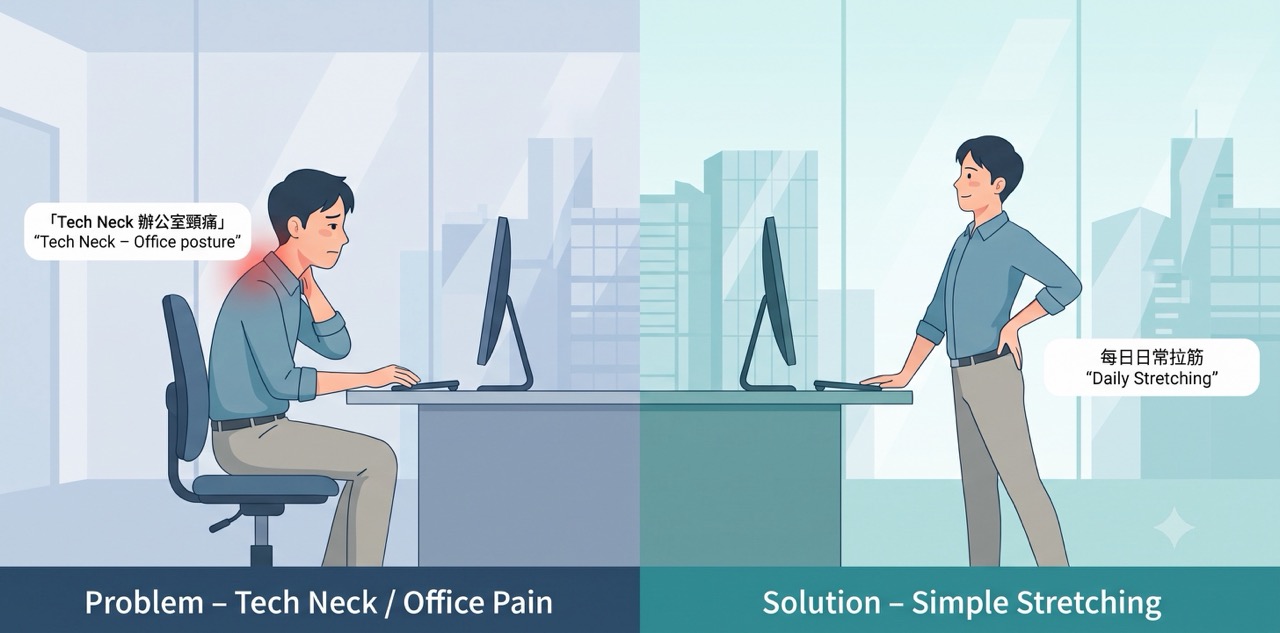
Office worker sitting with Tech Neck posture, holding their neck or lower back on the left, and the same worker on the right standing to stretch their lower back and hamstrings to support spinal health.

Chiropractic Care and Stretching: Why You Need Both

One of the most common misconceptions I encounter in practice is this: "I've had an adjustment — shouldn't everything be sorted now?"


Not quite. Chiropractic care and daily stretching work on different but complementary levels. Think of the adjustment as a system reinstall on a computer — immediately afterwards, everything runs smoothly. But if you go back to the same habits, accumulating clutter and never running a cleanup, it won't be long before performance degrades again. The adjustment is the reinstall. Your daily stretching is the maintenance routine.


The table below shows how I explain the distinction to patients:


Daily Stretching 🧘Chiropractic Care 🩺
PurposeReleases chronic tension; maintains daily flexibility and soft tissue health.Professional spinal adjustments to improve joint alignment and range of motion.
How they work togetherPost-treatment stretching prevents soft tissues from re-tightening; consolidates the effects of care.Assessment-guided care with a personalised stretching plan tailored to the individual.
Primary targetMuscles,tendons, ligaments.Joints, physiological alignment, nerve irritation and compression sites.
EffectGradual reduction in muscle tension, improved mobility, less proned to stiffnessImmediate improvement in joint range of motion, reduced joint pressure.
Sustained resultsCumulative; deepens over time with consistent habit; sarcomerogenesis can permanently increase muscle resting length.Immediate and noticeable; but without stretching to support it, soft tissue tension can cause gradual regression.
Impact on spinal alignmentIndirect support — reduces muscular pull on the spine, helps achieve better alignmentDirect adjustment — immediately improves mobility through Golgi Tendon response.
Effect on fasciaDirectly promotes fascial gliding; promotes lubrication.Improved joint mobility reduces overall fascial tension. Passive movement also promotes lubrication
Best suited forEveryone — especially post-treatment maintenance; also ideal for desk workers, people who look down at phones a lot, and anyone with poor postural habitsAnyone with muscular discomfort, limited joint movement, neck or back pain, sciatica, or those who need professional assessment
How to combine themDaily, consistently — especially as home care between and after chiropractic sessionsScheduled as appropriate, with a personalised stretching plan provided by your chiropractor

The adjustment opens the door. Stretching keeps it open.


Frequently Asked Questions

How long do I need to hold a stretch for it to be effective?

It matters less how long any single stretch lasts, and more whether you're doing it consistently every day. The goal is to give your nervous system and soft tissues enough repeated exposure to the movement that genuine adaptation can take place. One long stretch once a week will always lose out to a short stretch done daily.


Do I still need to stretch after a chiropractic adjustment?

Absolutely — and I cannot overstate this enough. A chiropractic adjustment can restore joint mobility and improve spinal alignment, but if the surrounding muscles remain chronically tight, they will gradually pull things back to where they were. Stretching is what locks in the gains. Without it, the effects of treatment are much more likely to be short-lived.


What is fascia, and why does it matter for the spine?

Fascia is the connective tissue that wraps around every muscle, organ, and structure in your body. When it becomes adhered through lack of movement, it places uneven mechanical load on the spine — contributing to discomfort and restricted movement. Stretching directly addresses this by promoting fascial gliding and stimulating the lubrication between layers.


Can stretching actually make muscles permanently longer?

Through the process of sarcomerogenesis, yes — consistent, sustained stretching can physically increase the resting length of a muscle by prompting the addition of new sarcomere units along the muscle fibre. This is a structural change, not a temporary feeling. However, it requires time and consistency to accumulate. There are no shortcuts — but the results are lasting.


What's Coming Next

In my next article, I'll be moving from the theory into the practical — sharing the stretches I actually recommend to my patients for daily spinal maintenance, including simple routines you can do at home without any equipment.


Spinal health rarely falls apart in a single moment. It erodes gradually — through the accumulated weight of poor posture, insufficient movement, and the kind of tension that builds so slowly you stop noticing it. Daily stretching is one of the most accessible ways to push back against that. But if you're already experiencing persistent neck tightness, back pain, or discomfort that doesn't ease with movement, that's your body telling you something worth listening to. A professional assessment by a registered chiropractor may be the right next step.


Follow me on Instagram and Facebook for more spinal health insights from Chiropractor Ronan Chan.


Daily Stretching and Spinal Health: Chiropractor Ronan Explains Why It’s About Far More Than Just “Loosening Up”

In my experience as a registered chiropractor in Hong Kong, daily stretching is not simply about making your body feel looser — it is a scientifically grounded spinal care habit. From spinal balance to intervertebral disc nutrition, the impact of daily movement on spinal health is far greater than most people realise.

Spinal health is not something Hong Kong people can afford to ignore. According to a spinal health survey published by Hong Kong Sanatorium & Hospital Group in 2024, 87% of respondents experienced spinal pain within the past year. Of those, 48% reported that their condition affected their sleep, 37% experienced anxiety, depression, or emotional distress as a result of pain or restricted movement, and 36% said their spinal problems even affected their work performance. These issues rarely appear overnight — they are the slow, cumulative result of prolonged sitting, constant phone-gazing, and posture that deteriorates bit by bit over time.
87% of respondents experienced spinal pain within the past year. Of those, 48% reported that their condition affected their sleep, 37% experienced anxiety, depression, or emotional distress as a result of pain or restricted movement, and 36% said their spinal problems even affected their work performance
As a registered chiropractor in Hong Kong, I consistently remind my patients that daily stretching is not an optional extra — it is an essential part of spinal maintenance. Many people think of stretching as nothing more than a warm-up, or something you squeeze in before and after exercise. But when done correctly and consistently, stretching helps release chronically tight muscles, reduces the pulling tension around the spine, and prevents the body from feeling progressively heavier and more locked up after long hours of sitting. This article aims to explain, in plain language, exactly why stretching and spinal health are so closely connected — and why the time you invest in it is genuinely worth it.

Spinal Balance: It's Not Just About Bones — It's About How Everything Works Together

A healthy spine isn't simply a matter of having "strong enough bones." The real key lies in whether the muscles and skeletal structures can maintain proper balance with one another. Think of your spine as a high-rise building: if the load-bearing columns are unevenly stressed over time and begin to tilt, structural problems will inevitably follow. The same principle applies to the human body. When certain muscle groups remain persistently tight, or when the body is held in an unnatural posture for extended periods, the spine comes under continuous strain — and over time, spinal alignment can gradually shift away from its natural position. This is an extremely common scenario in Hong Kong. Sitting in front of a computer for hours on end, looking down at a phone for much of the day, living and working in a way that offers very little physical movement — all of this keeps the body locked in a compressed, rigid state. Muscles grow tighter, and the load on the spine increases. In my practice, I often point out that stretching isn't just about getting a momentary release. It's about helping the body gradually return to a more natural state of balance, so that the spine and surrounding tissues are no longer under constant, excessive tension.

The Intervertebral Disc Needs Movement to Stay Nourished — Less Activity Means Faster Decline

Unlike most tissues in the body, intervertebral discs have no direct blood supply. They cannot receive nutrients the way other structures do — through the bloodstream. Instead, they depend on the mechanical movement of the spine itself: the repeated compression and decompression, flexion and extension of everyday movement, which helps drive nutrient exchange into the disc. When you sit still for too long, this exchange process slows down. The disc receives less nourishment, loses resilience, and becomes more susceptible to degeneration and discomfort. This is why so many of my patients wonder: "I haven't been doing anything strenuous — so why does my lower back feel so worn out?" The answer, more often than not, isn't overexertion. It's undermovement. Intervertebral discs depend on activity to stay in good condition. Leave them idle for too long, and they gradually lose their natural elasticity. This is precisely why I always emphasise that daily stretching and gentle movement aren't bonus care for your spine — they're foundational.

Stretching vs. Not Stretching: The Difference Shows Up in How You Feel Every Day

The comparison is straightforward: people who stretch regularly tend to maintain greater ease of movement in daily life. Those who don't stretch tend to accumulate tightness and stiffness over time. For the spine, the difference rarely announces itself in a single dramatic moment — it builds gradually, and you feel it in the small things: turning to look over your shoulder, bending down, getting up after sitting for a while.
Comparison of spinal posture with and without regular stretching — advice from registered chiropractor Ronan Chan in Hong Kong
Regular stretching helps maintain muscle balance and reduces the pulling force on the spine. Without a consistent stretching habit, muscles tend to remain chronically tight, gradually affecting spinal alignment. Chiropractor Ronan Chan recommends making stretching part of your daily spinal care routine.
Category ✅ With Regular Stretching ❌ Without a Stretching Habit
Muscle Condition More relaxed; tension distributed more evenly More prone to chronic tightness, pulling on the spine
Disc Condition Supports nutrient exchange; helps maintain disc resilience Reduced movement slows nutrient exchange; greater risk of degeneration
Morning Feel Body mobilises easily; movement feels natural and fluid Body tends to feel stiff; takes longer to "warm up"
After Prolonged Sitting Less noticeable tension around the spine when standing up Lower back more prone to stiffness and aching after sitting
Spinal Care Outcomes More supportive of maintaining a better state following professional care More likely to return repeatedly to a tight, uncomfortable baseline

Frequently Asked Questions

Does daily stretching actually help spinal health?

Yes, it does. In my clinical experience, daily stretching helps the body maintain better flexibility, reduces the strain that chronically tight muscles place on the spine, and supports nutrient exchange within the intervertebral discs — helping the tissues around the spine stay in better condition overall.

Why are Hong Kongers particularly prone to spinal problems?

Long hours at a desk, constant phone use, and limited daily movement are the primary contributors to spinal issues among Hong Kong's urban population. These habits lead to chronic muscle tightness and reduced disc nutrition. According to the 2024 survey by Hong Kong Sanatorium & Hospital Group, back pain (58%) and neck pain (54%) are the most common spinal complaints, followed by sciatica (30%).

Can stretching improve intervertebral disc degeneration?

Stretching is not intended as an immediate fix for disc degeneration. However, in my view, it can help the body maintain healthier movement habits, reduce prolonged tension in surrounding tissues, and support overall spinal health. If you are experiencing persistent discomfort, a professional assessment by a registered chiropractor in Hong Kong is always the right next step.

At what age should you start taking spinal health seriously?

The earlier, the better. In my experience, spinal problems are almost always the result of gradually accumulated habits — poor posture, insufficient movement, repeated strain. Establishing good stretching and movement routines from a young age significantly reduces the risk of developing chronic spinal issues later in life.

Coming Up Next: What Actually Happens Inside Your Body When You Stretch?

Spinal balance and intervertebral disc nourishment are just two of the ways that stretching supports your spine. If you want to go deeper — to understand what's actually happening inside your body during a stretch, how muscles receive signals, how fascia remodels, and what changes even at the cellular level — I'll be covering all of that in the next article.

If you've been experiencing persistent neck tension, back pain, lower back fatigue, or significant discomfort after prolonged sitting, your body may already be sending you signals worth paying attention to. Stretching is an important part of daily spinal maintenance — but if discomfort continues, a professional assessment by a registered chiropractor is the right next step to identify the true source of the problem and determine the most appropriate course of action.

Follow me on Instagram and Facebook for more spinal health insights.