
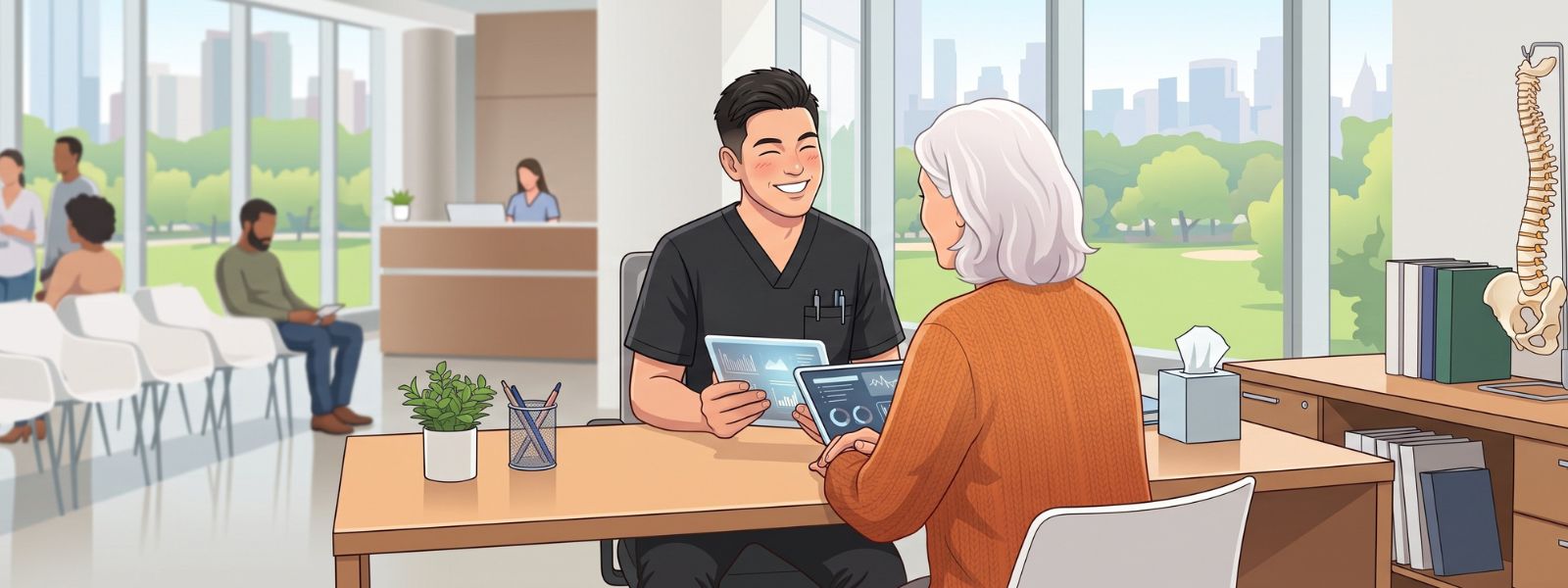
Every week, I sit across from a patient who cannot fully answer a question that should be simple: "What treatment have you had before, and what are you currently taking?" It's rarely their fault. Many of them have seen several doctors over many years, and details slip. Some pull out a crumpled plastic bag of medicine bottles from three different clinics and shrug. Others simply say, "I think I had something done to my back a few years ago, but I can't remember what." When I don't have the full picture, the treatment plan I build is only as good as the information I'm given — and that's exactly the gap that Hong Kong's Electronic Health Record Sharing System, known as eHealth, is designed to close.
When Patients Can't Remember Their Own Medical History
A Familiar Scene in My Consultation Room
If you've ever accompanied a relative to a check-up, you'll recognise this scene: the doctor asks "what medications are you on?" and everyone in the room starts guessing. I see this constantly in my own practice. A patient tells me about back pain, but forgets to mention they're also seeing a cardiologist, taking blood thinners, or that an X-ray was done at a public hospital eight months ago. It's not a memory problem unique to Hong Kong — it happens everywhere people juggle multiple clinics — but in a city where many residents move between public hospitals, private specialists, and community clinics, the paper trail gets scattered fast.
Why Missing Information Increases Treatment Risk
For a chiropractor, incomplete information isn't just inconvenient — it can directly affect how safely and appropriately I can proceed. If I don't know a patient recently had spinal imaging, I might order a test that has already been done. If I don't know about certain medications or existing conditions, I have to be more conservative with my assessment, which can slow down how quickly I understand what's really going on. This is precisely the kind of "information gap" that eHealth was built to help address, by giving authorised healthcare providers a shared, more complete picture of a patient's health record .
What Is eHealth and What Does It Actually Share
A Free, Lifelong, Two-Way Health Record System
eHealth is a platform developed by the Hong Kong Government that builds free, lifelong electronic health records for members of the public, enabling two-way sharing of health information among public and private healthcare providers. Participation is voluntary, territory-wide, and patient-oriented — meaning the patient decides who can access their records, and every participant's data is stored in encrypted electronic format. In simple terms, it's a shared filing cabinet for your health history, one that follows you whether you're at a public hospital, a private clinic, or — in my case — receiving chiropractic care.
The 11 Types of Data Doctors Like Me Can Access
According to eHealth, there are currently 11 types of shareable data, including personal identification and demographic data, allergies and adverse drug reactions, and diagnosis, procedures and medication records. For a family caring for an elderly parent, this means a healthcare provider authorised by that parent can check what medicine was prescribed during a previous visit, without the family needing to recall it from memory . For a child's caregiver, an authorised provider can check immunisation records the same way . Access isn't unlimited, either — eHealth applies role-based access control, so different authorised healthcare professionals are granted different levels of access according to their clinical needs, and providers can only view records of patients under their care with consent, on a "need-to-know" basis.
How I Use eHealth Before and During an Assessment
Seeing Past Diagnoses, Medications and Reports First
When a patient has joined eHealth and authorised me as their healthcare provider, I can review relevant diagnosis, medication and test-report information before I even begin a physical assessment. This is a meaningfully different starting point compared to relying purely on what a patient remembers to tell me in a ten-minute conversation. Instead of piecing together fragments, I get a documented reference — which is exactly the kind of quick access to health records that eHealth was designed to provide for healthcare professionals .
Cutting Down Repeat Tests and Reducing Risk of Error
One of the stated benefits of eHealth for healthcare providers is that it helps reduce repeated tests and potential errors associated with paper records . In practice, this might look like avoiding sending a patient for another imaging scan that was already done recently elsewhere, simply because I didn't know it existed. Fewer unnecessary repeat tests also means less time, less cost, and less exposure for the patient — particularly relevant for patients for whom extra clinic visits are physically tiring.
Why This Matters Even More for Seniors and Persons with Disabilities
Juggling Several Specialists at the Same Time
Many of my elderly patients are not seeing just one doctor. It's common for someone in their seventies to be following up with a cardiologist, an orthopaedic surgeon, and a general practitioner, all in the same month. Each of those visits generates records — prescriptions, test results, diagnoses — that may sit in different systems if not shared. When those pieces are scattered, no single provider, including me, has the complete picture unless the patient (or their family) manually gathers and repeats it every time.
When Patients Can't Fully Describe Their Own Health Picture
For elderly patients and persons with disabilities in particular, verbally recounting a complete, accurate medical history during a single consultation can be genuinely difficult — whether due to memory, communication difficulties, or simply the sheer number of past treatments involved. This is where the gap I described at the start of this article becomes most consequential, and it is exactly the population that benefits most from a system where records don't rely solely on memory or verbal recall.
| Aspect of Assessment | Without Shared Records | With eHealth Access |
|---|---|---|
| Reviewing medication history | Relies on patient/family recall | Authorised provider may access recorded medication data |
| Risk of repeat testing | Higher, if past reports are unknown | May be reduced, as noted in eHealth's stated benefits |
| Awareness of allergies/drug reactions | Depends on what patient remembers to mention | Recorded allergy and adverse drug reaction data may be available |
| Cross-specialist awareness | Fragmented across separate providers | Two-way sharing among authorised public and private providers |
Bringing eHealth Into My Home Visits
A home visit is different from a clinic consultation. I don't have a filing cabinet of past clinic notes sitting behind me, and there usually isn't a second professional in the room to help fill in gaps. Preparation before I even step through the door matters more here than almost anywhere else, and this is where having access to shared records ahead of time becomes especially useful. Where a patient has joined eHealth and authorised access, I'm able to arrive with a more informed picture of their health background, rather than piecing everything together on the spot.
A New Chapter: Home Chiropractic Care for Seniors and Persons with Disabilities
Now Covering Hong Kong Island, Kowloon and the New Territories
I'm currently expanding my home chiropractic service for seniors aged 65 or above and persons with disabilities, now covering Hong Kong Island, Kowloon, and the New Territories (excluding Stanley, Tai Tam, Shek O, Lantau, and the Outlying Islands), with no house-call fee charged for eligible patients. This service was designed with exactly the population described throughout this article in mind — people for whom travelling to a clinic can be difficult, and whose health history often spans multiple specialists and providers.
How eHealth Helps This Service Run More Efficiently
For home visits specifically, having access to a patient's shared health records — where the patient has joined eHealth and authorised access — can make a real difference to how efficiently and thoroughly I'm able to conduct an assessment on-site, without needing to rely entirely on what the patient or a family member can recall in the moment.
The home visit service generally includes:
- A spinal and postural assessment
- Chiropractic treatment appropriate to the assessed condition
- Guidance on posture and self-care at home
If you have a parent, relative, or someone under your care who may benefit from this kind of home-based professional assessment, you're welcome to reach out to learn more about the service and how it works.
Frequently Asked Questions
What is eHealth in Hong Kong?
eHealth is an electronic platform developed by the Hong Kong Government that builds free, lifelong health records for the public and enables two-way sharing of health information between public and private healthcare providers.
How does eHealth help my chiropractic assessment?
With patient authorisation, eHealth allows me to reference existing diagnosis, medication, and report information before an assessment, giving a more complete starting point than relying only on verbal recall .
Can eHealth reduce the need for repeated tests?
According to eHealth, one stated benefit for healthcare providers is a reduction in repeated tests and potential errors associated with paper-based records, which may help avoid unnecessary duplicate examinations .
Why is eHealth especially useful for seniors?
Seniors often see multiple specialists at once, and consolidating their records may help authorised providers, including chiropractors, access a fuller history without depending solely on memory .
Why is eHealth useful for persons with disabilities?
Persons with disabilities may face communication difficulties describing their full medical history verbally, so having authorised providers access recorded data may help reduce gaps in information .
Does joining eHealth cost anything for patients?
No. eHealth is described as a free, lifelong electronic health record system for members of the public, with participation on a voluntary basis.
How does eHealth support home chiropractic visits?
Reviewing available records beforehand, where authorised, allows more preparation ahead of an on-site assessment, which can support a more efficient and informed home visit.
How can I book a home chiropractic visit with Ronan?
Seniors aged 65 or above and persons with disabilities across Hong Kong Island, Kowloon, and the New Territories (excluding Stanley, Tai Tam, Shek O, Lantau, and the Outlying Islands) can enquire about the home chiropractic service, which currently has no house-call fee for eligible patients. You're welcome to get in touch to find out more.