
For many elderly people in Hong Kong, the Elderly Health Care Voucher can feel a bit like money tucked away in a savings account that nobody wants to touch. The government tops it up every year, the balance keeps growing, and eventually it hits the cap — quietly wasting resources that were meant to protect their health all along. The scheme was never designed to be a one-off sum you save for "a rainy day" or a major illness. Its real purpose is to encourage elderly residents to make regular use of private primary healthcare services, so that preventive check-ups and timely treatment can help them stay well for longer.
In this article, I want to walk elderly patients and their caregivers through everything about the Elderly Health Care Voucher Scheme in the simplest way possible — from who qualifies, to what it covers, to the accumulation cap, and finally, how to actually put it to good use instead of letting it sit idle.
1. What Is the Elderly Health Care Voucher Scheme?
The Health Care Voucher, officially known as the Elderly Health Care Voucher Scheme, is an electronic subsidy provided by the Hong Kong Government to help elderly residents access private primary healthcare services. Its aim is to ease the financial burden of preventive, curative and rehabilitative care. The scheme has been running electronically since it launched in 2009, so there is no physical paper voucher to collect — the amount is simply credited straight into a personal voucher account.
In short, the Health Care Voucher allows elderly residents to pay for private primary healthcare services according to their own health needs, and to freely choose the private healthcare professional they wish to see — including Medicine Practitioners, Chinese Medicine Practitioners, Dentists, and Chiropractors — without having to queue for public healthcare services every time.
2. Who Is Eligible for the Health Care Voucher?
According to the official Elderly Health Care Voucher Scheme website, eligible individuals must meet the following conditions:
Be aged 65 or above;
Hold a valid Hong Kong Identity Card, or a Certificate of Exemption issued by the Immigration Department;
The exception being where the individual's Hong Kong Identity Card was issued on the basis of a permission to land or remain in Hong Kong that has since expired or is no longer valid.
It is worth noting that there is no need to register or apply in advance for this scheme. As long as an elderly person meets the age and identification requirements, the voucher is issued automatically, and a personal account is set up on their behalf by the healthcare provider (such as a clinic) the first time they use it.
3. How Much Is Issued Each Year, and What Is the Accumulation Cap?
Every eligible elderly person currently receives HK$2,000 in vouchers each year, automatically credited to their personal account on 1 January. Unused amounts do not expire — they can be carried forward and accumulated indefinitely into future years. However, each account is subject to an accumulation cap of HK$8,000. In other words, if an elderly person rarely uses their vouchers and simply lets the balance build up, once the account reaches the cap, any newly issued amount that year cannot be credited in full, since it would exceed the limit.
In addition, the government has run the Elderly Health Care Voucher Pilot Reward Scheme since 2024, encouraging elderly residents to use their vouchers for preventive care on an ongoing basis. If an elderly person uses at least HK$1,000 worth of vouchers on designated primary healthcare services within the same year, they can receive an additional bonus of up to HK$500 in vouchers per year. This pilot scheme has been extended until 31 December 2028.
4. What Services Can the Health Care Voucher Be Used For?
The Health Care Voucher's coverage is fairly broad, extending to preventive, curative and rehabilitative private primary healthcare services. According to official information, the following categories of healthcare professionals registered in Hong Kong may enrol in the scheme and accept voucher payments:
Medicine Practitioners, registered Chinese Medicine Practitioners, and Dentists;
Chiropractors, registered nurses, and enrolled nurses;
Physiotherapists and occupational therapists (subject to existing referral arrangements);
Radiographers and medical laboratory technologists (subject to existing referral arrangements);
Optometrists registered under Part I of the register;
Audiologists, clinical psychologists, dietitians, and speech therapists (must be registered with a recognised professional healthcare body).
It is important to note that the Health Care Voucher cannot be used for hospitalisation, healthcare services requiring prepayment, or day surgery procedures, among others. Before seeking treatment, elderly patients and caregivers are advised to check directly with the healthcare provider whether they accept voucher payments and whether the specific service falls within the scheme's coverage.
A quota applies to optometry services: Since 2019, voucher use for optometry services (such as eye examinations and spectacle fitting) has been subject to a quota, capped at HK$2,000 every two years. This is meant to ensure that while elderly people can still benefit from optometry services, they retain enough balance for other primary healthcare needs.
5. How Does the Health Care Voucher Actually Work?
Using the Health Care Voucher is actually quite straightforward. Elderly patients and caregivers just need to keep the following steps in mind:
The elderly person must receive the healthcare service in person from the provider before the Health Care Voucher can be used to pay for it;
Present a valid Hong Kong Identity Card, or a Certificate of Exemption, to the registered healthcare provider and indicate that you wish to use the Health Care Voucher;
If this is the first time using the Health Care Voucher, the healthcare provider will set up a personal voucher account on the spot, at no extra charge;
The elderly person needs to provide a mobile phone number capable of receiving text messages (a family member's or caregiver's number can be used instead) in order to receive deduction notifications;
The elderly person confirms the transaction using a smart identity card reader (if this is not possible due to special circumstances, a paper consent form can be signed instead);
The healthcare provider will print a "Voucher Usage Record" for the elderly person to keep, showing the balance before deduction, the amount deducted, and the remaining balance.
Caregivers can help keep these usage records safe, and can also check the account balance anytime through the eHealth mobile app, or by calling the Voucher Enquiry Hotline at 2838 0511 — making it easier to plan voucher use in advance.
6. How Can You Make Better Use of the Health Care Voucher Instead of Just Saving It?
Out of habit or a sense of thrift, many elderly people feel they should "save the voucher for when a serious illness strikes." Year after year, the balance simply accumulates, and it often ends up being wasted once it hits the HK$8,000 cap. In reality, the Health Care Voucher was designed precisely to encourage regular preventive check-ups and timely treatment, rather than waiting until a problem has already worsened before seeking care.
For those who spend long hours on computers and mobile phones, the degeneration of the cervical and lumbar spine tends to accelerate with age, often faster than expected. Arranging regular health check-ups, spinal assessments, or physiotherapy as part of primary healthcare can help you stay aware of changes in your body sooner — and this is one professional option worth considering. Rather than letting the Health Care Voucher sit quietly in an account gathering dust, turning it into part of a regular health management routine may be a more practical way to make it work for you.
7. How Can You Avoid Wasting the Health Care Voucher?
To avoid losing voucher value once the accumulation cap is reached, caregivers can help elderly family members regularly review their account balance and plan ahead for how to use it. Below is a summary of common scenarios and suggested approaches:
Common Health Care Voucher scenarios and suggested approaches
Scenario
Possible Issue
Suggested Approach
Health Care Voucher account balance is close to the HK$8,000 cap
The new amount issued that year may not be credited in full, as it would exceed the cap
Plan ahead — for example, arrange a Chiropractic Body Check, physical or dental check-up
Elderly person rarely seeks treatment and vouchers sit unused
Missed opportunities for regular preventive care
Consider arranging at least one primary healthcare assessment per year, such as a spinal check-up or dental examination
Uncertainty about whether a provider accepts the Health Care Voucher
Unable to use the Health Care Voucher on the spot during a visit
Check the list of registered healthcare providers, or confirm with clinic staff, before the appointment
Heavy use of the Health Care Voucher on optometry services
May exceed the HK$2,000 quota per two-year period
Understand the quota arrangement and keep enough balance for other primary healthcare needs
Caregivers can also make use of the Spouse Account Linking arrangement — if one spouse's voucher balance has been used up, the other spouse's remaining balance can be used to pay for related services, giving the household more flexibility in how they use their combined voucher resources.
Conclusion: The Real Value of the Elderly Health Care Voucher Lies in Using It Wisely
The Elderly Health Care Voucher Scheme was never meant to be just another "government benefit" — it is really a gentle reminder for elderly residents to pay regular attention to their own health. Rather than letting it sit untouched in an account, why not turn it into part of your everyday health management? Whether that means a dental check-up, an optometry assessment, or a professional assessment of your spine and musculoskeletal system, these are all directions worth considering.
As a side note, Ethica Health, located in Central, Hong Kong, is run by Dr. Ronan Chan, a Hong Kong Registered Chiropractor. Elderly patients can use their Health Care Voucher to pay for Chiropractic Body Check / treatment here as well. If you or someone you care for would like to learn more about this professional option within primary healthcare, you are welcome to visit our website for details or to book a consultation.
Frequently Asked Questions
Q1. Do I need to apply every year to receive the Health Care Voucher?
No. The Health Care Voucher is issued automatically and electronically. Eligible elderly residents receive HK$2,000 into their personal account every 1 January, with no need for prior registration or application, and no paper vouchers are issued.
Q2. Does the unused balance of the Health Care Voucher expire?
There is no expiry date. Unused amounts can be carried forward and accumulated year after year, but each account has a total accumulation cap of HK$8,000, beyond which additional amounts may not be credited.
Q3. Can the Health Care Voucher be used for chiropractic services?
Yes. According to the official list under the Elderly Health Care Voucher Scheme, Hong Kong Registered Chiropractors are among the eligible healthcare providers, and elderly patients can use their Health Care Voucher to pay for chiropractic assessments and related primary healthcare services.
Q4. Can a caregiver use the Health Care Voucher on behalf of an elderly person?
The elderly person must receive the healthcare service in person before the Health Care Voucher can be used. Caregivers may accompany them to appointments and help provide a contact number to receive deduction notifications, but the use of the voucher itself must be confirmed by the elderly person (or their guardian, under special circumstances).
Q5. Can the Health Care Voucher be used for hospitalisation?
No. The Health Care Voucher cannot be used for hospitalisation, healthcare services requiring prepayment, or day surgery procedures. It is intended mainly for private primary healthcare services.
Q6. Can a married couple share their Health Care Vouchers?
Yes. Couples can apply to link their voucher accounts, so that once one spouse's balance is used up, the other spouse's remaining balance can be used to pay for related services — giving the household more flexibility in how their combined resources are used.
Q7. How can I check the balance of my Health Care Voucher account?
Elderly residents and caregivers can check their account balance and usage history anytime through the eHealth mobile app, the Elderly Health Care Voucher Scheme website, or by calling the Voucher Enquiry Hotline at 2838 0511.
Q8. Are there restrictions on using the Health Care Voucher for optometry services?
Yes. Since 2019, Health Care Voucher use for optometry services has been subject to a quota, capped at HK$2,000 every two years. This is designed to allow elderly residents to benefit from optometry services while still retaining enough balance for other primary healthcare needs.
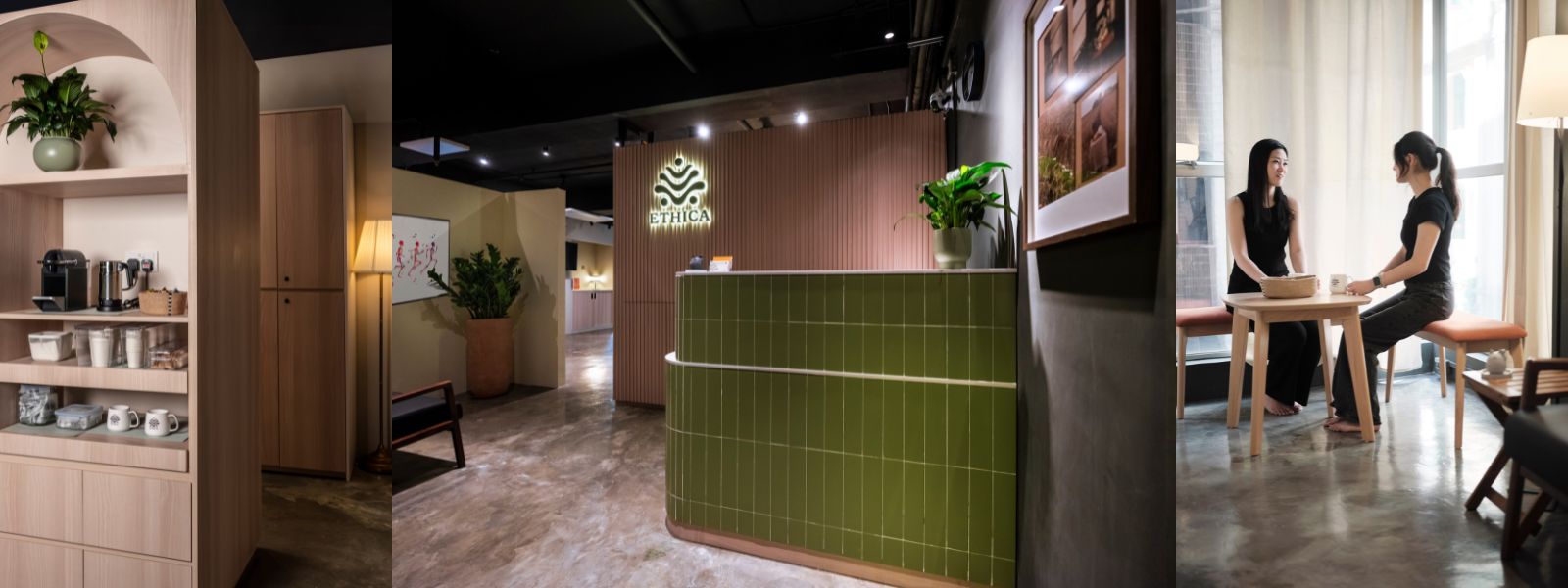
Step inside Ethica Health, and your first thought is likely to be: this doesn't feel like a clinic.
No harsh overhead lighting. No sterile white walls. No that particular antiseptic smell that makes your shoulders creep up before you've even signed in. What greets you instead feels almost disarmingly calm — and that, as it turns out, is entirely by design. This is the vision of Dr. Ronan, founder and registered chiropractor, quietly embedded into every corner of the space.
The Room Itself Is Part of the Treatment
Most of us carry a low-level tension into any clinical setting. Even a routine appointment can bring with it a vague unease — a stiffening of the spine, a mental blankness where all those carefully rehearsed questions used to be. By the time you're sitting across from the practitioner, half of what you wanted to say has already slipped away.
It isn't anyone's fault. It's simply what years of associating healthcare with urgency and discomfort can do to the nervous system.
Dr. Ronan understands this intimately. His belief is that genuine recovery doesn't begin on the treatment table — it begins the moment a person feels safe enough to let their guard down. And so, rather than leaving that to chance, he built it into the bones of Ethica Health itself: warm timber tones in place of clinical white, soft diffused lighting instead of the kind that makes everything feel like an examination. The space does the work quietly, before a single word is spoken.
Walk through the door, and something in you — almost involuntarily — begins to settle.
Designed to Calm, Not Just to Function
The interior palette leans into warm wood and muted, natural tones, lit in a way that feels closer to a considered home than a waiting room. It's a deliberate choice, and not merely an aesthetic one. When the body isn't braced against its surroundings, muscles ease, the nervous system softens, and chiropractic adjustments can take effect more fully. The environment, in other words, is doing clinical work of its own.
One visitor described stepping into Ethica Health as feeling like arriving at an urban retreat — somewhere you go to be genuinely supported, rather than simply seen to and sent on your way.
Care That Starts With Listening
Beyond the physical space, Ethica Health is built around a philosophy that puts the patient at the centre of every interaction. Dr. Ronan takes the time to understand not just the immediate complaint, but the full context — daily habits, posture patterns, the pressures that accumulate quietly over time. He explains what is happening in the body and why, in language that is clear without being condescending.
For those coming to chiropractic care for the first time, this matters enormously. When you understand the reasoning behind each adjustment — when the process stops feeling mysterious and starts feeling logical — the apprehension lifts. What replaces it is something more useful: a real understanding of your own body, and a grounded confidence in the path forward.
At Ethica Health, there's space to say what you're actually feeling, including the things that seem too vague or too minor to mention. The conversation here is shaped around you.
Treating the Root, Not Just the Symptom
Dr. Ronan's approach resists the quick fix. Rather than managing pain at the surface, the work at Ethica Health is concerned with what lies beneath — structural alignment, neurological function, the way emotional load and lifestyle choices accumulate in the body over time. Through precise, gentle manual adjustments, misaligned joints and vertebrae are guided back into position, restoring balance and allowing the body to move as it should.
The clinic also weaves in a yoga programme — morning sessions, midday decompression classes — as a quiet reminder that recovery is not only something that happens during an appointment. It's something you can carry with you, even through the middle of a very full week.
FAQ
Where is Ethica Health located?
Ethica Health is situated at 1/F, Unit A, 128 Wellington Street, Central, Hong Kong.
Who is Ethica Health's chiropractic care suited for?
Whether you spend long hours at a desk, are navigating postpartum recovery, train regularly as an athlete, or are managing sciatic pain, Ethica Health offers tailored assessment and care to suit your specific needs.
What is a chiropractic adjustment?
A chiropractic adjustment involves the precise, manual repositioning of misaligned spinal joints to improve the function of the neuromusculoskeletal system and reduce discomfort. It does not involve surgery or medication.
What services does Ethica Health offer?
Alongside chiropractic adjustments, Ethica Health provides Chiropractic Body Check, postural assessments, yoga workshops, and corporate wellness programmes — bringing structural care and everyday health habits into conversation with one another.
The body never lies. It speaks to you in ways you might not always notice — the stiffness in your neck when you wake up, the dull ache in your lower back after hours at a desk, or that hard-to-describe exhaustion that just won't go away. We get so used to pushing through these signals, until one day, they become too loud to ignore.The first time chiropractic truly moved me was witnessing someone go from feeling their absolute worst to walking out feeling like themselves again. It wasn't simply the pain going away — it was a person reclaiming ownership of their own body. In that moment, I found my direction.
Why I Chose Chiropractic
Most people picture chiropractic as a series of satisfying clicks and cracks — something you turn to when your back gives out. That's not entirely wrong, but it's only a small part of the picture.
The philosophy behind chiropractic is to see the person as a whole — not just a body that needs fixing, but a complete human being with emotions, a life, and social connections. During my Masters of Chiropractic at McTimoney College of Chiropractic, I encountered a framework that resonated deeply with me: Holistic Biopsychosocial Care.
At its core, this model addresses three interconnected dimensions:
Biological (Bio): The physical state of muscles, joints, and the nervous system
Psychological (Psycho): Stress, emotions, sleep, and mental health
Social (Social): Lifestyle habits, work environment, relationships, and community support
Why include the social dimension? Because the reality is this: a professional grinding through a high-pressure job may have neck pain that goes far beyond posture. A new mother's back pain may carry the weight of exhaustion and emotion. Physical symptoms are often a reflection of the whole person. If care only addresses the body, we're only treating half the story.
Why Hong Kong?
After completing my training in the UK and earning dual registration with both the General Chiropractic Council (UK) and the Hong Kong Chiropractic Council, coming home to practice was never a difficult decision — because Hong Kong is exactly that. Home.
I know this city's rhythm. I understand the pressures people here carry: the relentless work culture, the packed schedules, and the deeply ingrained habit of only seeking help when things have already gone wrong.
That sense of relatability is, to me, one of the most important foundations of good care. When you feel that the person in front of you genuinely understands your living, something shifts — and that connection is where healing begins.
The Birth of Ethica Health: A Different Kind of Space
Ethica Health grew from a quiet conviction that healthcare could feel different.
What I wanted to create was something different — not just a place for treatment, but a space where people could walk in and immediately feel at ease. Here, you are not a symptom to be resolved. You are a person — one who deserves to feel heard, cared for, and supported.
Ethica Health currently focuses on chiropractic care — practice by hand, in the tradition it was built on. The clinic itself is intentionally designed to feel unlike a typical medical setting; warm, calm, and unhurried. I believe that an environment where you feel safe and relaxed is not separate from the healing process — it is part of it.
Practice as Responsibility
I often reflect on the fact that physical discomfort is rarely just a physical problem. The stress that builds up over years, the emotions that get pushed aside, the self-care that gets quietly abandoned in the rush of city life — these things accumulate, and one day, they surface as pain. What starts as a physical complaint can quietly become another layer of pressure in an already demanding life.
I chose this path because I genuinely believe that every person has the capacity to understand their own body better, and every person deserves to be truly listened to — not just processed. That belief is what makes being a chiropractor feel less like a job and more like a commitment to the community I care about.
Helping the people of Hong Kong learn to listen to their bodies, and build healthier rhythms into their everyday lives — that is what I carry with me every time I walk into Ethica Health.
Frequently Asked Questions
Where did Dr. Ronan Chan train as a chiropractor?
Dr. Ronan Chan completed his Master of Chiropractic (MChiro) at McTimoney College of Chiropractic in the UK. He holds dual registration with the General Chiropractic Council (UK) and the Hong Kong Chiropractic Council.
What is Dr. Ronan Chan's approach to care?
Dr. Ronan Chan practices Holistic Biopsychosocial Care — an approach that addresses the physical, psychological, and social dimensions of health simultaneously, treating the whole person rather than focusing solely on symptoms.
What services does Ethica Health currently offer?
Ethica Health currently provides chiropractic care, delivered through traditional hands-on treatment. The long-term vision is to grow into a multidisciplinary wellness community, collaborating with professionals across different areas of healthcare.
Where is Ethica Health located?
Ethica Health is located at 1/F, Unit A, 128 Wellington Street, Central, Hong Kong — approximately 7 minutes on foot from Exit D2 of Central MTR Station.
Is chiropractic only for back pain?
Not at all. Chiropractic care encompasses the spine, joints, nervous system, and overall health management. It also takes into account a person's psychological wellbeing and social circumstances, making it a genuinely holistic approach to health.